


Website by CWS
Autism in Northern Virginia: Prevalence, School Data, and Early Intervention Resources
April 29, 2026
Introduction
Northern Virginia is home to one of the most educated, highly resourced, and closely monitored school systems in the United States. And that matters when it comes to autism, because how well a region identifies autism is as important as how common it is.
The autism statistics in Northern Virginia tell a story that is shaped by Fairfax County's exceptional identification infrastructure, by demographic diversity across the region's six major jurisdictions, and by a special education system that is in some ways, more advanced than anywhere else in the state. Understanding those numbers in context is what helps families decide what to do next.
Here's the direct answer: Northern Virginia reports autism identification rates that are equal to or above the national average of 1 in 31 children (CDC ADDM Network, 2022). Among Northern Virginia's school jurisdictions, Alexandria City has the highest percentage of students with autism at 2.17%, followed by Arlington County at 1.92%. Fairfax County has the highest absolute number of students with autism of any jurisdiction in the region, 6,470 students identified, which is nearly triple the number of the next largest county. Virginia reports adult autism prevalence exceeding 2.3%. Northern Virginia's higher rates reflect its strong identification infrastructure, early screening programs, and a special education system that the state's own parent advocacy organization, POAC-NoVA, has called a national leader in autism services, not simply a higher underlying incidence.
What Is Autism Spectrum Disorder?
Before unpacking the data, it helps to ground the conversation in what autism actually is. Autism Spectrum Disorder (ASD) is a developmental condition affecting communication, behavior, and social interaction. It's called a spectrum because presentation varies enormously from person to person, some autistic individuals have minimal verbal communication and need significant daily support, while others communicate fluently and live independently with little outside help.
Common characteristics include differences in social communication and language, repetitive behaviors or focused interests, and sensory sensitivities to sound, light, texture, or touch. When statistics describe "1 in 31 children," they describe a wide range of individual profiles, not a single condition with a single set of needs.
National Context: Where the Numbers Start
Before diving into Northern Virginia specifically, it helps to understand what the national picture looks like.
According to the CDC's Autism and Developmental Disabilities Monitoring (ADDM) Network's most recent full report (2022 data, published April 2025):
- 1 in 31 children aged 8 years were identified with ASD across 16 ADDM Network surveillance sites, up from 1 in 36 in 2020
- Autism prevalence has risen steadily from 1 in 150 in 2000 to 1 in 31 in 2022, a trajectory driven by improved screening, expanded diagnostic criteria, and better access to diagnostic services
- Autism now accounts for approximately 15% of all school-age students receiving services under IDEA nationally, up from 14% in 2023
- The autism category accounted for 40% of the total growth in IDEA-eligible students in 2024
Virginia is not a designated CDC ADDM surveillance site, meaning there is no CDC-managed county-level surveillance data for Northern Virginia equivalent to Maryland's Johns Hopkins-led program. Virginia's autism statistics are drawn primarily from VDOE school enrollment data, state special education reports, and federal IDEA child count submissions.
Autism Statistics in Northern Virginia: What the School Data Shows
Because Virginia does not participate in the CDC's ADDM clinical surveillance network, the most reliable and current autism statistics in Northern Virginia come from school enrollment data, specifically, the Virginia Department of Education (VDOE) records of students identified with autism under IDEA.
This data source has a specific lens: it captures children who have been identified as having autism and are receiving special education services. It does not capture children who have not been evaluated or who receive support through other pathways.
Northern Virginia Jurisdiction Comparison
Among Northern Virginia's major school jurisdictions, the following patterns are documented based on VDOE data:
Alexandria City — Highest autism identification rate as a percentage of students: 2.17% of all students identified with autism. Alexandria City also saw a notable 11% increase in autism identification from the previous reporting year, one of the sharpest year-over-year increases in the region.
Arlington County — Second highest rate at 1.92% of students identified with autism. Arlington runs one of the most established autism-specific programs in Northern Virginia, the Multi-intervention Program for Autism (MiPA) for school-age children, with a separate mini-MiPA program for preschoolers.
Fairfax County — Highest absolute number: 6,470 students with autism identified, approximately triple the number of the next largest jurisdiction in the region. Fairfax County's student enrollment is double the size of the second largest jurisdiction (Prince William County), which partly explains this difference.
Prince William County — The second largest jurisdiction by number, with approximately one-third the autism caseload of Fairfax despite being the second largest county by enrollment.
Falls Church City and Prince William County — Both reported the lowest autism identification rates in the region at approximately 1.01% each.
These figures reflect identification rates, not necessarily actual prevalence. Higher identification rates in Alexandria and Arlington are consistent with greater concentrations of pediatric specialists, higher healthcare access, and more established developmental screening programs. Falls Church City's lower rate may partly reflect its very small size and population rather than lower actual prevalence.
Fairfax County Autism Statistics: A Closer Look
Fairfax County Public Schools (FCPS) deserves specific attention in any discussion of autism statistics Northern Virginia families care about. With 6,470 students identified with autism, FCPS serves more autistic students than almost any single school district outside of the largest urban districts nationally.
POAC-NoVA, Parents of Autistic Children of Northern Virginia, the region's leading autism advocacy organization, has described Fairfax County as having long been considered a national leader in special education and services for students with autism.
Specific features of Fairfax County's autism identification and service infrastructure include:
Seven specialized public day schools — FCPS operates seven centers serving students with the most severe and complex disabilities, including students from neighboring jurisdictions who cannot be served locally.
ABA-based classroom programs — FCPS is the only Virginia school district with classrooms dedicated to instruction specifically based on Applied Behavior Analysis (ABA), an evidence-based practice endorsed by POAC-NoVA.
Preschool Autism Class (PAC) program — FCPS Early Childhood Special Education runs a dedicated Preschool Autism Class program using ABA and Verbal Behavior methodology for preschool-age children with ASD. The program provides systematic instruction in a structured setting with a reduced adult-to-student ratio, supporting communication, social skills, and IEP-specified skill targets.
Child Find program — FCPS actively identifies, locates, and evaluates children residing in Fairfax County who may be in need of special education and related services, including those not yet enrolled in school.
Autism specialists and behavioral support — FCPS deploys autism specialists and behavioral support staff who consult with IEP teams, provide Functional Behavior Assessments (FBAs), and develop Behavior Intervention Plans (BIPs).
The scale and depth of Fairfax County's autism identification infrastructure partly explain its high caseload numbers. A county that screens earlier, more comprehensively, and with more specialized tools will identify a larger proportion of its autistic students than a county with fewer resources, even if underlying prevalence is similar.
Divine Steps ABA · Northern Virginia Data Report
Autism Statistics in
Autism Statistics in
Northern Virginia
:
What the Numbers Mean for Families
Northern Virginia has some of the most robust autism identification infrastructure in the country. Here's what the school data, county comparisons, and Fairfax County's exceptional numbers actually tell us.
6,470
Students with autism in Fairfax County — largest absolute count in Northern Virginia
VDOE data via POAC-NoVA
2.17%
Alexandria City — highest autism identification rate in Northern Virginia by percentage
VDOE via POAC-NoVA comparison
>2.3%
Virginia adult autism prevalence — above national average
Apex ABA / Blossom ABA, citing state data
Direct answer:
Northern Virginia autism identification rates equal or exceed the national average of 1 in 31 (CDC ADDM 2022). Alexandria City leads the region at 2.17%, Arlington at 1.92%. Fairfax County has 6,470 autistic students — nearly triple the next largest jurisdiction. These higher rates reflect Northern Virginia's exceptional diagnostic infrastructure, early screening programs, and ABA-based school services — not simply higher underlying prevalence.
Northern Virginia doesn't have a CDC clinical surveillance site like Maryland. Virginia autism statistics come primarily from VDOE school enrollment data
— children identified with autism who are receiving special education services under IDEA. This captures identified and served children, not the full population. Bars below show identification rate as a percentage of total students enrolled.
"Fairfax County has long been considered a national leader in special education and services for students with autism."
— POAC-NoVA (Parents of Autistic Children of Northern Virginia), Comparison of NoVA School Jurisdictions. POAC-NoVA is the region's primary autism advocacy organization and publishes detailed assessments of what each Northern Virginia school district offers families of autistic children.
Fairfax County Public Schools (FCPS) · Autism Services
Why Fairfax County stands apart from every other NoVA jurisdiction
With 6,470 autistic students, Fairfax County's numbers are shaped by both its large size and its exceptional identification infrastructure. FCPS is the only Virginia school district with ABA-based classrooms, runs seven specialized day schools, and serves students from neighboring jurisdictions that cannot match its capacity.
Seven specialized public day schools
FCPS operates seven specialized centers serving children with the most severe and complex disabilities — including students from neighboring school jurisdictions that cannot serve them locally.
Only NoVA jurisdiction with this capacity
ABA-based classroom programs
FCPS is the only Virginia school district with classrooms dedicated to Applied Behavior Analysis (ABA)-based instruction for students with autism — an evidence-based practice endorsed by POAC-NoVA. ABA workshops are also offered to parents of children in these programs.
Endorsed by POAC-NoVA · Unique in Virginia
Preschool Autism Class (PAC)
FCPS Early Childhood Special Education runs dedicated PAC programs using ABA and Verbal Behavior (VB) methodology for preschool-age children (ages 2.5–5). Reduced adult-to-student ratio. Targets communication, social skills, and IEP-specific skill goals.
ABA + Verbal Behavior for ages 2.5–5
Child Find program
FCPS actively identifies, locates, and evaluates children residing in Fairfax County who may need special education — including those not yet enrolled in school. Referral not required. Free to all families.
Free · No referral required
Why Northern Virginia reports higher autism rates than most of Virginia
Higher concentration of developmental pediatricians and child neurologists per capita
Higher rates of private health insurance coverage enabling earlier evaluation access
More established early screening protocols in pediatric practices and pre-K programs
Strong special education reputation attracts families who relocate for services
Highly educated population with greater autism awareness and proactive evaluation pursuit
CDC: geographic rate differences reflect identification practices, not higher underlying prevalence
Early identification pathway in Northern Virginia
1
Birth to age 2 — Infant & Toddler Connection of Virginia
Virginia's Part C IDEA early intervention program. Services delivered in the child's natural environment — typically home. Free, and no formal autism diagnosis required if developmental delay is documented.
2
Age 2.5–5 — FCPS Preschool Autism Class (PAC)
ABA and Verbal Behavior-based preschool program in Fairfax County. Structured, reduced-ratio setting targeting communication, social skills, and IEP goals. Only program of this type in Northern Virginia.
3
Age 3–21 — IDEA Part B school services + IEP
At age 3, children transition to school division services under IDEA Part B. Includes a legally binding IEP, all required special education and related services, and FAPE protections. Families may request a Child Find evaluation at any time at no cost.
4
In-home ABA therapy — complementing school services
Evidence-based ABA therapy at home reinforces skills across environments. Covered by Medicaid and most private insurance in Virginia. Divine Steps ABA serves Northern Virginia with no waitlist, aligning therapy goals with IEP objectives.
Key autism resources for Northern Virginia families
POAC-NoVA
Parents of Autistic Children of Northern Virginia — advocacy, education, in-person support groups, and jurisdiction comparison guides. Region's primary family advocacy organization.
Autism Society of Northern Virginia (ASNV)
Community-building, advocacy, and education for autistic individuals and their families across Northern Virginia.
Fairfax County CSB — Autism Resources
Fairfax County Community Services Board connects families to school, community, and government autism services including waiver programs and respite care.
FCPS Parent Resource Center
Special Education Parent Handbook in seven languages. Information on the IEP process, disability-specific programs, and community resources.
VCU Autism Center for Excellence (VCU-ACE)
VDOE-funded statewide training center supporting evidence-based practices for children and youth with ASD from early childhood through postsecondary transition.
Four things Northern Virginia autism statistics mean for your family
1
Earlier identification is improving — but average age of diagnosis in Virginia is still 5.3 years, above the national average. Many children miss the early intervention window.
2
Where you live affects what services your child can access. Jurisdiction matters. POAC-NoVA's school comparison guide helps families understand what each district offers.
3
IEP quality varies significantly across NoVA. Active advocacy — backed by data from ABA providers and knowledge of your FAPE rights — produces better outcomes.
4
ABA therapy is covered by Virginia Medicaid and most private insurance. In-home ABA that aligns with IEP goals extends therapy impact across home and school settings.
Divine Steps ABA · Northern Virginia
Supporting a child with autism in Northern Virginia?
Divine Steps provides personalized in-home ABA therapy with no waitlist and full insurance support including Medicaid. We collaborate with FCPS and other NoVA IEP teams.
Divine Steps ABA · No Waitlist · Medicaid Accepted
"Northern Virginia's autism statistics
"Northern Virginia's autism statistics
show the need. We're here to meet it."
Our BCBA-led team serves families across Northern Virginia with in-home ABA therapy that aligns with IEP goals, accepts Medicaid and private insurance, and begins without a waitlist.
Sources: CDC MMWR 2025 (16 Sites, 2022 data) · Advocacy Institute IDEA Data 2024
POAC-NoVA School Jurisdiction Comparison · Virginia Department of Education — Autism Spectrum Disorder
FCPS Early Childhood Special Education (PAC) · FCPS Community Resources for Families
Fairfax County Community Services Board · PubMed — ABA Evidence Base 2024
Divine Steps ABA · divinestepstherapy.com
Virginia Autism Statistics: The Broader State Picture
Northern Virginia sits within a statewide context worth understanding. Virginia reports an adult autism prevalence rate exceeding 2.3%, somewhat above the general national adult estimate.
The Virginia Department of Education (VDOE) governs special education services for all autistic students in Virginia through its Division of Special Education and Student Services. Key elements of Virginia's autism services infrastructure include:
VCU Autism Center for Excellence (VCU-ACE) — A state-funded center in partnership with VDOE providing training and technical assistance across Virginia to improve services for children and youth with ASD from early childhood through post-secondary transition.
Virginia Autism Council — A council of autism experts working to define skill competencies and advance training for professionals and caregivers supporting individuals with autism statewide.
Communities of Leaders in Autism (CoLA) — A VDOE-supported network of division-based professionals sharing practices and research-based strategies for system-wide improvement in autism outcomes.
Virginia's 2024 Special Education Roadmap — Following external reviews in October 2023, VDOE developed a 2024 Roadmap for Special Education with increased focus on inclusion, high-quality instruction, family engagement, and postsecondary pathways for all learners including those with autism.
Virginia received a Final Monitoring Closure Letter from the U.S. Department of Education's Office of Special Education Programs (OSEP) in December 2024, indicating the state had addressed previously identified concerns in its IDEA implementation.
Why Northern Virginia Autism Rates Are Higher Than State and National Averages
The fact that Alexandria City and Arlington County report autism identification rates above 2% — while Falls Church and Prince William hover around 1%, raises an important question: does Northern Virginia actually have more autism, or does it just find it better?
The answer is largely the second. Several structural factors push Northern Virginia's autism identification rates upward relative to the rest of Virginia:
Concentration of pediatric specialists. Northern Virginia has a higher concentration of developmental pediatricians, child neurologists, and pediatric psychologists per capita than most of Virginia. Children in these areas are more likely to be referred for and receive a comprehensive autism evaluation.
High healthcare coverage. Northern Virginia has among the highest rates of private health insurance coverage in the state, meaning more families can access diagnostic evaluations that might otherwise be delayed by cost or insurance limitations.
Robust early screening infrastructure. Fairfax County, Arlington, and Alexandria have well-established developmental screening protocols in pediatric practices and school pre-kindergarten programs. Earlier, more systematic screening catches more children at younger ages.
Strong special education systems that attract families. Families of autistic children sometimes relocate to jurisdictions with stronger special education systems. Northern Virginia's reputation for autism services means its districts serve some autistic students whose families moved there specifically for those services.
High community awareness. Northern Virginia's highly educated population correlates with greater parental awareness of autism signs and more proactive pursuit of evaluation when concerns arise.
The CDC explicitly notes that geographic differences in autism identification rates reflect differences in identification practices and access to services, not necessarily differences in the actual biological prevalence of autism.
A Northern Virginia Family's Journey: What Early Identification Looks Like in Practice
Statistics describe what's happening at the population level, but for families, the question is what early identification looks like in everyday life. We recently worked with a family in Fairfax County whose journey illustrates how the system can work when families act early.
The parents noticed developmental concerns before their child's second birthday, limited speech, difficulty with eye contact, and challenges with peer interaction at daycare. They weren't sure what those signs meant or where to start. Their pediatrician completed an initial developmental screening and referred the family for a formal evaluation. Their child was diagnosed with autism shortly after.
Within weeks, the family had enrolled in in-home ABA therapy through Divine Steps and connected with their school division's early intervention services. Over the following year, communication improved measurably, first single words, then two-word combinations, then short requests. Social engagement deepened. By the time the child entered preschool, they were participating in classroom routines with appropriate support and a clearly defined IEP.
We have seen similar outcomes across Northern Virginia. The variable is rarely talent or luck, it is how early services begin, how consistently they continue, and how well home-based therapy aligns with the goals a child's school team is working toward.
The Early Identification Picture in Northern Virginia
Early identification is where Northern Virginia has one of its strongest advantages, and where families can do the most with the data.
Virginia provides early intervention services for children from birth to age 2 through the Infant & Toddler Connection of Virginia, the state's Part C IDEA early intervention program. Children who qualify receive individualized services in their natural environment, typically at home. At age 3, children transition to IDEA Part B services administered through local school divisions.
FCPS runs its Preschool Autism Class (PAC) program for children aged 2.5 to 5, using ABA and Verbal Behavior methodology, giving Fairfax County families access to structured, evidence-based preschool programming that most Virginia counties do not offer.
Research consistently shows that children who begin
ABA therapy and other evidence-based interventions before age 5, and particularly before age 3, achieve stronger outcomes in communication, adaptive behavior, and school readiness. The earlier the intervention, the greater the benefit from the developing brain's neuroplasticity.
For families in Northern Virginia who have a new autism diagnosis or developmental concerns, the two most important immediate steps are:
- Contact the local school division's Child Find program to initiate a special education evaluation (free, no referral required)
- Connect with an ABA therapy provider to begin in-home services that reinforce school-based goals
Northern Virginia Families — Supporting a child with autism in Northern Virginia? Divine Steps provides personalized in-home ABA therapy with no waitlist and full insurance support including Medicaid. We collaborate with IEP teams across Northern Virginia to align therapy and school goals.
Get in touch | Call: 888-301-4065
Northern Virginia Autism Resources: What Families Can Access
Understanding autism statistics in Northern Virginia is most useful when paired with knowledge of what supports are available in the region.
Fairfax County Community Services Board — Autism Resources. The Fairfax County Community Services Board maintains a dedicated autism resources page connecting families to school-based, community, and government services across Fairfax County. Includes information on waiver programs, respite care, and recreational programs for children and adults with autism.
POAC-NoVA (Parents of Autistic Children of Northern Virginia). The region's primary autism advocacy and family support organization. Provides education, community support, and in-person support group meetings for caregivers. Has published comparative assessments of autism services across all Northern Virginia school jurisdictions, an invaluable resource for parents choosing where to seek services.
Autism Society of Northern Virginia (ASNV). Mission focused on improving the lives of autistic individuals and their families through community-building, advocacy, and education. ASNV is the local chapter of the Autism Society of America.
The Arc of Northern Virginia. Promotes and protects the rights of people with intellectual and developmental disabilities, including autism. Supports full inclusion and participation in community life across Northern Virginia.
FCPS Parent Resource Center. Fairfax County Public Schools maintains a Parent Resource Center with Special Education Parent Handbook resources (available in seven languages), information on the special education process, and support for families navigating IEPs for autistic students.
Virginia's Medicaid Waiver Programs. Virginia operates Medicaid waiver programs that can cover ABA therapy and other autism-related services. The Commonwealth Coordinated Care Plus (CCC+) waiver and the Building Independence waiver are two programs available to eligible Virginians with autism.
In-Home ABA Therapy. Divine Steps ABA provides evidence-based ABA therapy across Northern Virginia with no waitlist, accepting Medicaid and private insurance. Our BCBAs work directly with family IEP teams to ensure therapy goals are aligned with school-based objectives.
What Northern Virginia Autism Statistics Mean for Your Family
Four evidence-based conclusions families can draw from the current data:
1. Earlier identification is improving — but gaps remain. FCPS's Child Find program and PAC preschool services mean Fairfax County children are often identified earlier than in less-resourced Virginia counties. But across Northern Virginia, children are still being identified at an average age of approximately 5.3 years, above the national average. Many children are still entering school without a diagnosis and without appropriate support.
2. Where you live affects what services your child can access. Alexandria City and Arlington County have higher identification rates than Falls Church and Prince William, partly reflecting different levels of diagnostic and educational resources. Families who choose their school jurisdiction strategically, or who supplement school-based services with in-home ABA therapy, give their children access to more consistent, high-quality support.
3. School services require active advocacy. Virginia requires school divisions to provide FAPE (Free Appropriate Public Education) under IDEA, including autism-specific IEP services. But the quality and depth of IEP planning vary significantly across Northern Virginia's jurisdictions. POAC-NoVA publishes a comparison of NoVA school jurisdictions specifically to help families understand what each district offers and what to advocate for.
4. ABA therapy is covered and effective. ABA therapy has the strongest evidence base of any autism intervention, with decades of peer-reviewed research supporting improved communication, adaptive behavior, and school outcomes. In Virginia, ABA therapy is covered by Medicaid and most private insurance plans, making it accessible to most Northern Virginia families regardless of income.
Conclusion
Autism statistics in Northern Virginia tell a story of a region that is better than most at finding autism in its children, and, in Fairfax County especially, better than most at serving them once found. The 6,470 autistic students in FCPS alone represent both a significant community need and a significant investment in specialized services.
But the data also shows that identification still happens later than it should for many children, that service quality varies meaningfully across jurisdictions, and that families who understand the system, and who supplement school services with evidence-based in-home therapy, achieve better outcomes for their children.
Divine Steps ABA is ready to be your family's partner in Northern Virginia. Our BCBA-led team brings individualized, in-home ABA therapy in Maryland, Virginia, and North Carolina with no waitlist, full Medicaid and insurance support, and active collaboration with your child's school IEP team.
Northern Virginia's autism statistics show the need. We're here to meet it. Contact us today!
Frequently Asked Questions
What are the autism rates in Northern Virginia?
Northern Virginia's autism identification rates equal or exceed the national average of 1 in 31 children. By jurisdiction, Alexandria City leads at 2.17% of students identified with autism, followed by Arlington County at 1.92%. Fairfax County identifies 6,470 students with autism in absolute terms, the largest count in the region by far. Falls Church City and Prince William County report the lowest rates at approximately 1.01% each.
How many students with autism are in Fairfax County schools?
Fairfax County Public Schools identifies approximately 6,470 students with autism, nearly triple the count of the next largest jurisdiction in Northern Virginia. This reflects both Fairfax County's large overall student enrollment and its exceptionally well-developed identification infrastructure, including Child Find, a Preschool Autism Class (PAC) program, ABA-based classroom instruction, and seven specialized public day schools.
Why does Northern Virginia report higher autism rates than the rest of Virginia?
Higher identification rates in Northern Virginia reflect stronger diagnostic infrastructure, not necessarily higher underlying prevalence. The region has a denser concentration of pediatric specialists, higher healthcare coverage, more established developmental screening protocols, and special education systems that some families specifically relocate to access. The CDC explicitly notes that geographic differences in identification reflect differences in identification practices and access to services.
What autism services are available through schools in Northern Virginia?
What autism services are available through schools in Northern Virginia?
Northern Virginia school divisions provide special education services to autistic students under IDEA, including Individualized Education Programs (IEPs), specialized instruction, speech and occupational therapy, behavioral support, and related services. Fairfax County offers ABA-based classroom programs and a dedicated Preschool Autism Class (PAC), the only program of its type in Northern Virginia. Arlington runs the Multi-intervention Program for Autism (MiPA), with a separate program for preschool-age children. Every jurisdiction operates a Child Find program that evaluates children at no cost to families, including those not yet enrolled in school.
How early can ABA therapy start for children with autism?
ABA therapy can begin as early as 18 months of age in many cases, and research consistently shows that earlier intervention produces stronger outcomes, particularly for communication, adaptive behavior, and school readiness. In Virginia, ABA therapy is covered by Medicaid and most private insurance plans, often without requiring a long waitlist when families choose providers like Divine Steps that have immediate openings. Families can also access Virginia's Infant & Toddler Connection for early intervention services from birth to age 2 before transitioning to school-based services at age 3.
How do families access autism resources beyond the school system?
Families in Northern Virginia can access autism support through multiple non-school channels: community organizations like POAC-NoVA, Autism Society of Northern Virginia (ASNV), and The Arc of Northern Virginia provide advocacy, support groups, and educational resources; the Fairfax County Community Services Board connects families to waiver programs, respite care, and recreational programs; Virginia's Medicaid waiver programs (including CCC+ and Building Independence) can cover ABA therapy and related services; and in-home ABA providers like Divine Steps deliver evidence-based therapy that complements school-based IEP goals.
SOURCES:
https://www.fairfaxcounty.gov/community-services-board/
https://poac-nova.org/
https://www.asnv.org/
https://thearcofnova.org/
https://www.dmas.virginia.gov/for-members/benefits-and-services/waivers/

ABA potty training supports bathroom skills at your child's pace. Small goals and caregiver practice shape the routine.
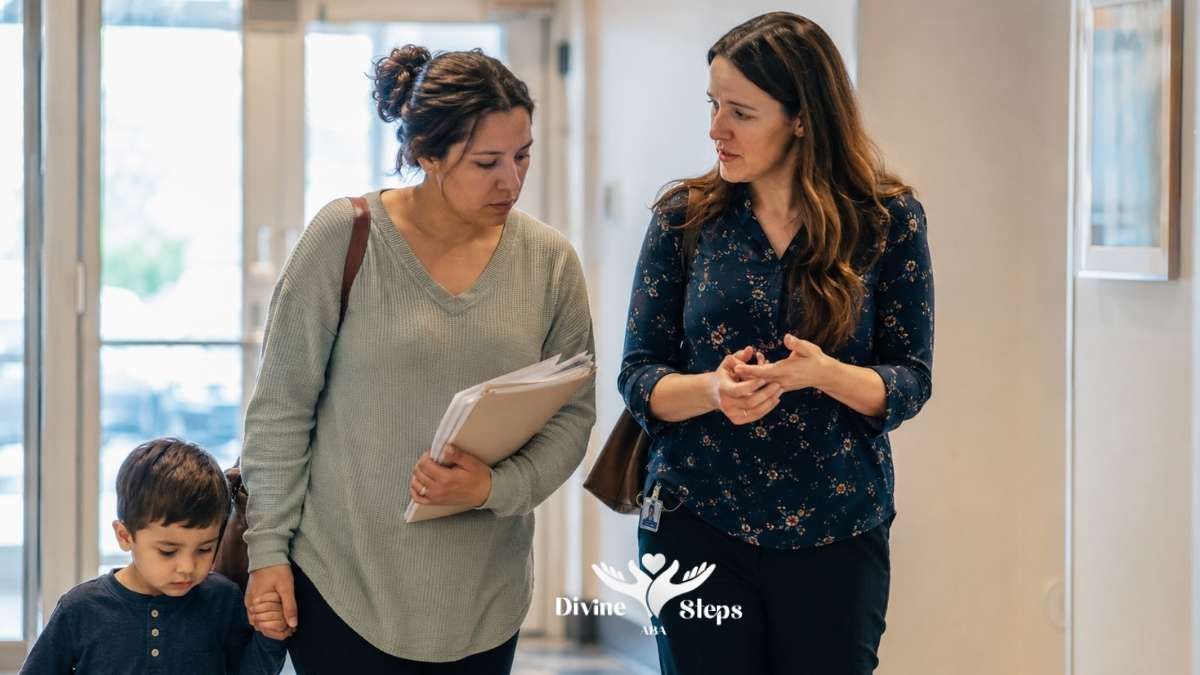
What to do after an autism diagnosis starts with the report. See state programs, school rights, and ABA intake tips.

ABA therapy out-of-pocket cost depends on your care and plan. A worked example explains deductibles and coinsurance.