


Website by CWS
A Weekly ABA Therapy Plan for Summer Break Progress
July 27, 2026
Key Points:
- An ABA therapy summer break plan keeps communication, daily living, social, and flexibility goals active through brief practice in family routines.
- A weekly schedule should include formal sessions, visual anchors, downtime, and clinician-approved strategies.
- Simple notes help caregivers adjust goals and share useful observations with the BCBA.
Applied Behavior Analysis (ABA) goals can stay active through an ABA therapy summer break plan without making every summer day feel scheduled. School may be out, therapy hours may change, and sleep may drift later. Your family still needs room for rest, trips, visitors, and ordinary fun. A useful plan focuses on four areas: communication, daily living, social participation, and flexibility.
This guide gives you a weekly template you can reuse instead of a long list of activities. Formal treatment decisions should stay with your child’s Board Certified Behavior Analyst (BCBA). The BCBA should approve any change to treatment hours, goals, teaching steps, or behavior procedures within your in-home ABA therapy plan.
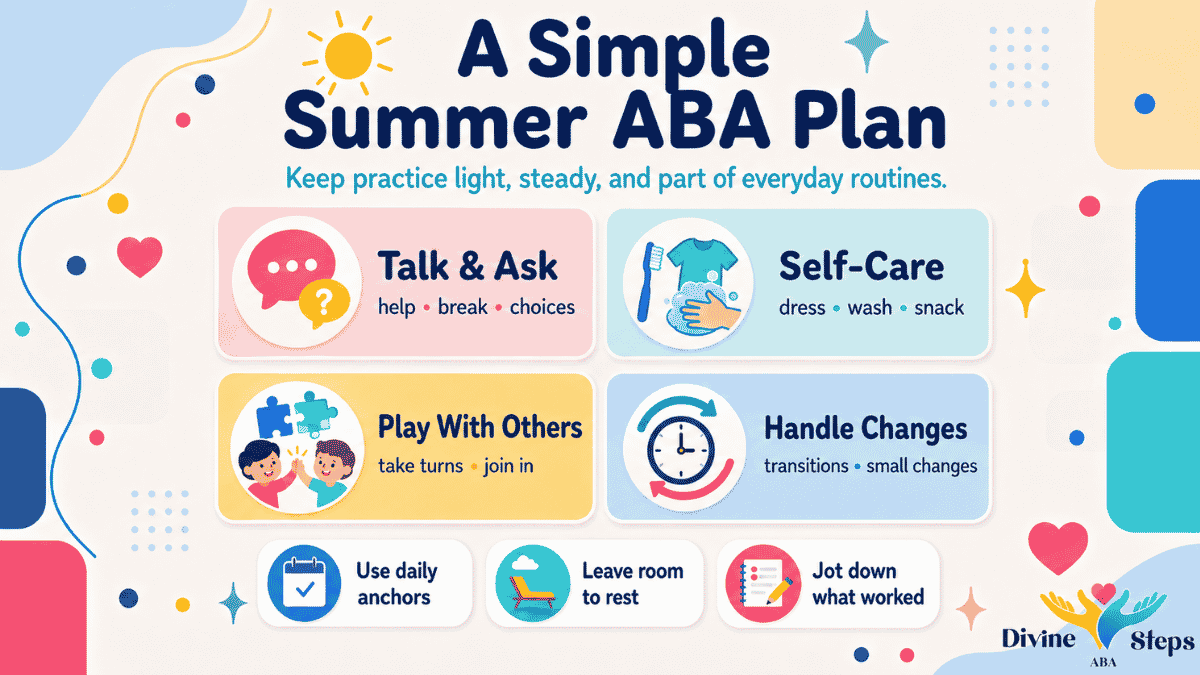
Build an ABA Therapy Summer Break Plan Around Four Weekly Goals
A weekly ABA therapy summer break plan needs one goal from each area. That gives the week structure without filling every hour.
- Communication: Requesting help or a break, answering one question, or using a communication device.
- Daily living: Dressing, handwashing, toothbrushing, snack preparation, or cleanup.
- Social participation: Taking turns, joining sibling play, greeting people, or waiting during an outing.
- Behavior and flexibility: Following a transition cue, accepting a small change, or using a replacement response.
A meta-analysis of 51 effect sizes suggests that parent-led practice can support positive outcomes when parents receive direct coaching. Focusing on these areas helps you design a successful ABA therapy summer break routine.
A weekly plan cannot guarantee against autism regression during breaks. A few difficult days after a routine change do not prove a loss of skill.
Parents can record the change, then discuss it with the clinician.
Set the Summer ABA Therapy Schedule Before Monday
Creating your summer ABA therapy schedule before the week begins reduces daily stress.
Follow these simple steps:
- Put formal sessions first. Keep treatment hours aligned with your child's clinical plan.
- Choose three daily anchors. Use routine times like breakfast, play, and bedtime.
- Insert one skill opportunity. For example, practicing dressing supports daily independence, while requesting a toy during play builds communication.
- Schedule downtime. Rest and favorite games belong on the calendar.
- Make it visual. Use pictures, written words, or cards to show the sequence.
- Prep for changes. Mark upcoming appointments, travel, or visitors.
This visual approach helps your family manage ABA therapy schedule changes during summer without extra stress.

Use This Weekly Template to Practice Skills in Real Life
How Continuing ABA Skills at Home Fits Into Each Day
Focusing on continuing ABA skills at home does not mean turning your living room into a clinical environment. Rather, these are brief, natural practice opportunities built directly into your normal daily activities.
You can use simple everyday moments to reinforce progress instead of planning long, structured sessions. Simply use the exact strategies your clinical team has already shared during parent coaching sessions. This keeps the process comfortable for both you and your child.
| Day | Main Purpose | Sample Practice | Parent Note |
|---|---|---|---|
| Sunday | Prepare the week | Choose four goals, add appointments, and prepare the visual schedule | Record any expected disruptions |
| Monday | Communication | Practice requesting food, help, toys, or a break during familiar routines | Count independent requests |
| Tuesday | Daily living | Practice one part of dressing, hygiene, meal preparation, or cleanup | Record the level of prompting |
| Wednesday | Social participation | Practice turn-taking with siblings or joining a short community activity | Record whether the child stayed engaged |
| Thursday | Flexibility and transitions | Use a timer, first then direction, or visual cue before changing activities | Note which cue helped |
| Friday | Mixed practice | Use two familiar skills in a different room, with another caregiver, or during an outing | Watch for skill use in the new setting |
| Saturday | Family use and recovery | Keep practice light during meals, play, errands, or family events | Record one success and one concern |
To make this weekly template work, follow these five principles:
- Communication practice: Natural requests should produce natural results. If your child asks for water, give them water.
- Daily living practice: Only teach the specific step you discussed with your clinical team. Do not change the full task order.
- Social practice: Siblings are great play partners, but they should not act as therapists. Let them enjoy their own playtime.
- Community practice: Local recreation programs or community activities provide venues to practice waiting, requesting help, following group routines, and taking breaks. Cities like Raleigh and Charlotte in North Carolina, or counties across Maryland and Virginia, offer sensory-friendly summer activities. Before enrolling, review the staffing ratios, sensory environments, communication support, and safety procedures.
- Generalization: Use Friday to check if a skill appears with a different caregiver, in a new room, or during an outing.
At Divine Steps, we help families turn current treatment goals into routines they can use all summer.
Talk to us.
Our in-home ABA therapy services and parent training program support families across Maryland, Virginia, and North Carolina.

Adjust the Plan When Summer Stops Following the Plan
How to Adjust Your ABA Therapy Summer Break Plan After a Hard Week
An ABA therapy summer break plan can fall apart after travel, poor sleep, missed sessions, illness, or caregiver fatigue. The next week does not need a complete restart.
Three smaller adjustments can make the plan manageable again:
- One steady anchor: Breakfast or bedtime stays predictable.
- A lighter workload: One or two goals remain active instead of every goal.
- A gradual return: Another practice period returns when the child and caregiver can take part.
“I don’t want my home to feel like therapy all day” is a fair concern. Maintaining ABA progress during school break does not require constant instruction. Short practice inside routines that already happen can protect family time. Preferred play, rest, and outings should remain part of the week.
The supervising clinician should hear from parents before treatment procedures, reinforcement systems, communication requirements, or behavior plans change. Notes about sleep, refusal, missed sessions, or new behavior can help the clinician decide what needs attention.
Review Friday Notes Before Planning the Next Week
You do not need a complex spreadsheet to track progress. A simple notebook works. Review your notes and check one easy measure for each goal.
You might track:
- Independent communication responses
- Toothbrushing steps completed without help
- Minutes spent playing with siblings
- Successful transitions
- Prompts used
- Places where skills occurred
These brief notes help you decide what to do next. You can choose to continue the same goal if it still needs practice. If the skill works well at home, change the setting. If prompting increases, ask your clinical team for support. Sharing these observations helps coordinate with school-based ABA therapy teams when classes resume.

FAQs About an ABA Therapy Summer Break Plan
Does this weekly plan replace my child's regular ABA sessions?
No. This plan supports your child's goals between sessions. It does not replace prescribed treatment hours, clinical supervision, or direct therapy. Your supervising clinician should decide whether formal sessions continue, increase, decrease, or change during the summer.
Should siblings take part in summer skill practice?
Siblings may join games, conversations, or outings when participation feels natural. Keep expectations age-appropriate and allow siblings to decline. The sibling's role is family participation, not treatment delivery.
How can grandparents or babysitters follow the plan?
Give other caregivers a visual schedule, one or two target skills, and the response steps already approved through your ABA therapy services. Consistent wording helps them succeed. Caregivers should write down any concerns instead of introducing new consequences.
Protect Your Child’s Summer Progress With a Home-Based Plan
A useful summer plan keeps a small number of skills active through communication, self-care, play, transitions, and family routines. This regular practice gives your family structure without turning summer break into another heavy school term.
At
Divine Steps Therapy, we provide in-home ABA therapy and parent training for children through age 11 across Maryland, Virginia, and North Carolina.
Call 888-541-1868 or submit our online contact form to discuss your child's goals, insurance, and summer availability. Our team will explain the intake process and help determine the right service schedule.

What to do after an autism diagnosis includes reviewing the report, calling insurance, and starting ABA and school referrals. Contact Divine Steps.

Switching ABA therapy providers can preserve goals, data, and routines while reducing care gaps. Your child's transfer can start with Divine Steps.

In-home vs school-based ABA therapy compares goals, routines, caregiver roles, access, and skill practice. Find the right setting with Divine Steps.