


Website by CWS
ABA Preference Assessments: How Therapists Learn What a Child Enjoys
November 11, 2026
Key Points:
- A preference assessment in ABA identifies possible teaching supports by recording what a child chooses or spends time with.
- A preferred item counts as a reinforcer only when it increases a particular behavior.
- Parent observations help therapists notice changing interests and decide what to explore next.
A child may reach for bubbles on Monday and spend more time with building blocks on Thursday. Both choices give the therapist information about what interests the child at that moment.
A preference assessment in ABA therapy turns those observations into information the team can compare. Families can help by sharing what they notice during everyday play, including activities their child has recently stopped enjoying.
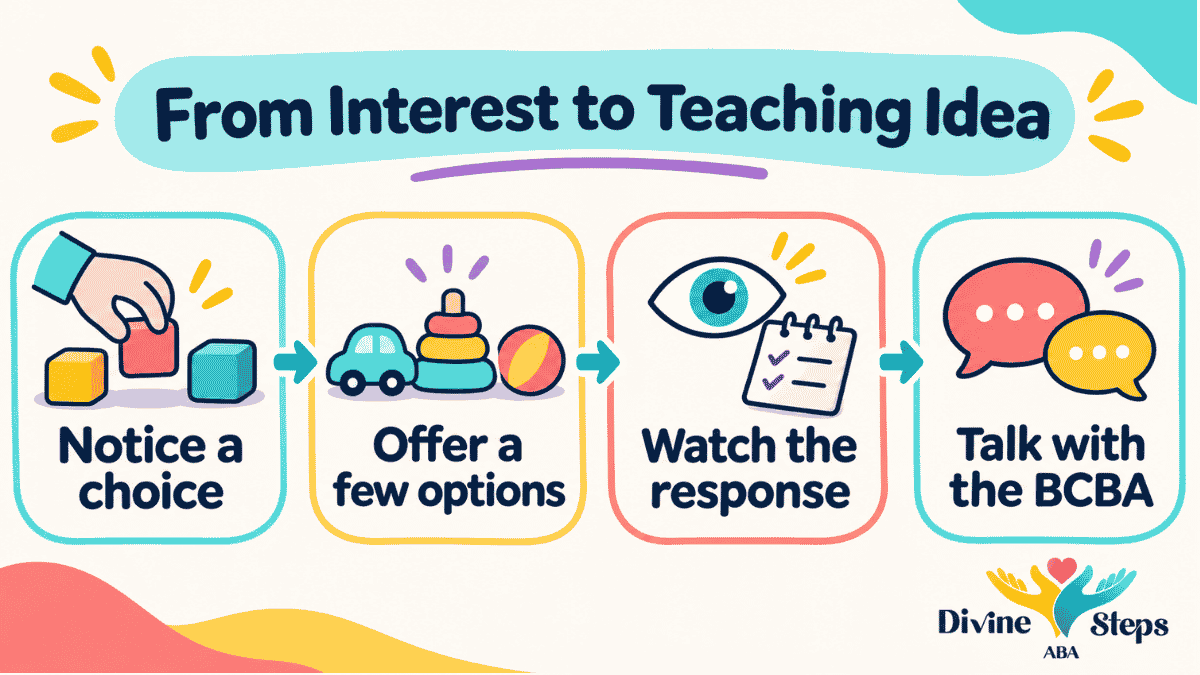
What Is a Preference Assessment in ABA?
A preference assessment identifies items, activities, or interactions a child prefers. Applied behavior analysis, or ABA, uses those findings to identify possible reinforcers: things that may help a child practice a skill more often.
The assessment may explore interests such as:
- Toys: Cars, puzzles, or building blocks.
- Activities: Drawing, dancing, or listening to music.
- Interactions: Singing together or playing a familiar game with an adult.
Some methods produce a
preference ranking, which puts the available options in order based on the child’s responses. That ranking compares only the choices included. A puzzle ranking above two other toys does not establish that puzzles are the child’s favorite activity everywhere.
What Happens During an ABA Preference Assessment?
The therapist gathers possible interests, observes the child’s responses, and records patterns. A Board Certified Behavior Analyst, or BCBA, selects an approach based on the child’s needs and how they make choices.
Parents may notice four parts of the process:
- A conversation about interests. Caregivers describe familiar favorites, new activities, and recent changes.
- Observation or planned choices. The child explores available activities or chooses among options, depending on the method.
- Notes about responses. The therapist records selections, time spent playing, or other responses the assessment measures.
- A review of the findings. The team considers which options to explore during teaching and what needs further checking.
Spoken answers are not the only way to show an interest. Depending on the assessment, a child may reach, point, look toward an option, or use a communication device.
Through our
in-home ABA therapy, our BCBAs at Divine Steps Therapy visit families to assess their child’s needs. Our treatment plans consider the child’s interests, and parents contribute information about daily life. Families wondering how assessment relates to ongoing visits can also read about
what happens during an in-home ABA session.
Five Common Types of Preference Assessments
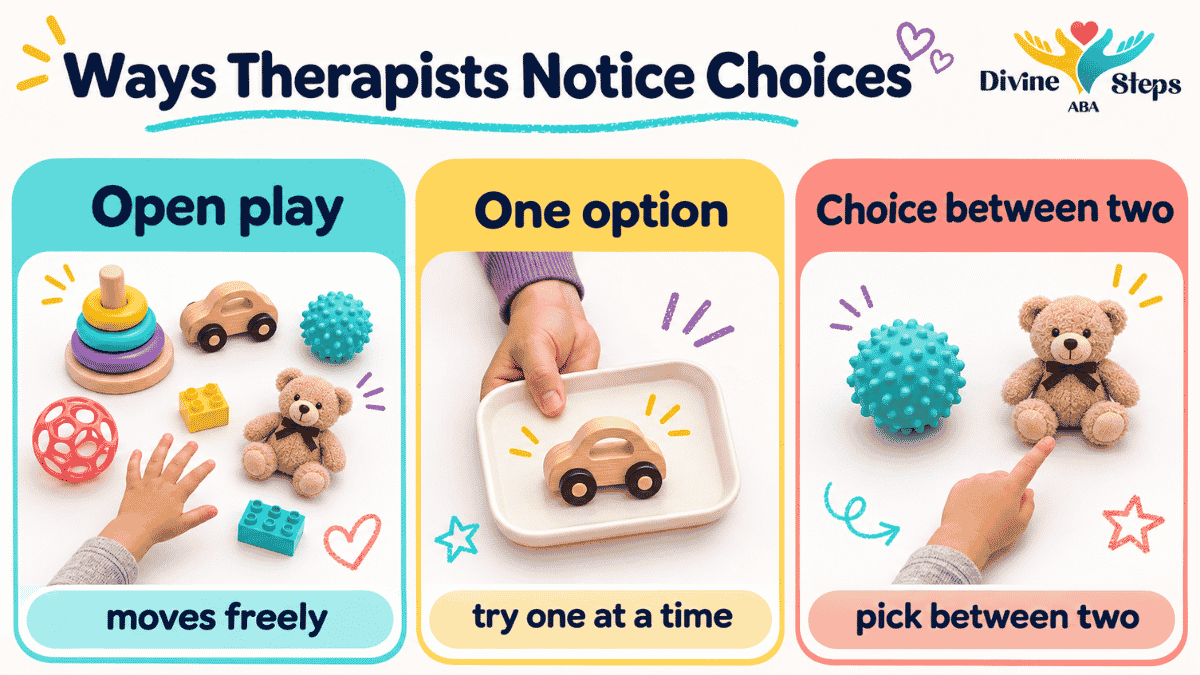
The five common direct formats differ in how therapists present choices and record responses. In assessment names, “stimulus” means something presented to the child, such as a toy.
| Assessment Type | What Parents May Notice |
|---|---|
| Free-operant observation | Several options remain available while the therapist records what the child engages with and for how long. The child can move between activities. |
| Single stimulus | The therapist presents one option at a time and records whether the child approaches or engages with it. |
| Paired stimulus | Two options appear together. The therapist compares different pairs and records which option the child chooses. |
| Multiple stimulus with replacement, or MSW | The child selects from several options. After brief access, the chosen item returns for the next choice alongside new alternatives. |
| Multiple stimulus without replacement, or MSWO | The child selects from several options. After access, the selected item leaves the remaining choices within that round. The therapist records the selection order. |
These formats describe different ways to observe preferences, rather than five steps every child must complete.
Caregiver interviews and surveys provide another source of information, called an indirect assessment. They gather reports from people who know the child instead of observing the child’s responses directly.
The
assessment method depends on the child’s needs. The BCBA considers whether the child can look across several items, choose between options, and return toys comfortably. Distress calls for stopping and reviewing the approach. Parents can share sensory or movement needs before the assessment begins.
Preference Assessment vs. Reinforcer Assessment
A preference assessment identifies what a child appears to enjoy. A reinforcer assessment tests whether access to an option increases a particular behavior. Enjoyment alone does not establish that effect.
| Assessment | Main Question |
|---|---|
| Preference assessment | Which options does the child choose or engage with? |
| Reinforcer assessment | Does access to an option make a particular behavior happen more often? |
In a hypothetical example, a child repeatedly chooses a toy train. That finding suggests train play may be worth exploring during teaching.
The therapist then checks whether train play after a taught request helps that request happen more often over time. The behavior data establish whether the activity functions as a reinforcer in that situation. Research has used
separate assessments to test reinforcer effects after identifying preferred items. A favorite toy does not guarantee learning.
Why Might a Child Lose Interest in a Former Favorite?
A child’s interests can change with recent access, available alternatives, and the situation. An activity that held attention yesterday may have less appeal today.
Possible reasons include:
- Recent play: A child may want something different after a long period with the same toy.
- New options: A newly discovered activity may attract more attention.
- Different circumstances: The same option may appeal more in one setting or moment.
- Changing interests: Children discover other activities as they grow.
Preference assessments in ABA may need repeating when the child stops engaging with a former favorite. The timing depends on the child and circumstances; one daily or weekly schedule will not suit everyone.
Parent Observations That Help the BCBA
Parents can share what their child chooses, moves away from, and enjoys differently across the week. Specific observations give the BCBA more context than a broad statement such as “he likes toys.”
ABA Preference Assessment Examples From Everyday Play
The preference assessment examples below show how everyday observations can lead to questions for the therapist.
| Parent Observation | Question for the BCBA |
|---|---|
| “She returned to her building blocks several times during free play.” | “Could block play be worth exploring during teaching?” |
| “He moved away when the musical toy started.” | “How should we account for that response?” |
| “She showed little interest in bubbles after playing with them all morning.” | “Could recent access have affected her choice?” |
These descriptions report what happened without assigning a reason. Moving away from music could prompt further discussion. The observation alone does not explain why the child left.
A short note can include the activity, when it happened, and what the child did. Parents don’t need to score trials or create a formal ranking to contribute. During the next conversation, families can ask which interests the therapist noticed and what changes to share between visits.
We include parents in care and provide updates and strategies for the week. In a
published parent review, Tye J. described our team listening to concerns and following up. That exchange gives families room to share details from home.
FAQs About Preference Assessments in ABA
Can an RBT conduct a preference assessment?
A trained Registered Behavior Technician, or RBT, can conduct preference assessments within their competence and under qualified supervision. The BACB’s RBT task requirements include preference assessments. RBTs do not provide independent services. Supervision does not mean a BCBA must stand beside the RBT throughout every assessment.
Is a preference assessment an autism test?
A preference assessment does not diagnose autism. An autism diagnostic evaluation examines whether a person meets diagnostic criteria. Learning about interests also serves a different purpose from assessing communication, daily living, or other skills. Preference findings form one part of a broader understanding of the child.
How long does a preference assessment take?
The length depends on the method, number of options, and child’s needs. A brief play observation and a series of paired choices can take different amounts of time. The BCBA can explain whether the assessment will happen within a larger visit or during an ongoing session.
Explore a Therapy Plan Built Around Your Child’s Interests
A child’s interests give the therapy team starting points for learning activities. Observations and teaching data help the team decide which options support the child’s goals.
We support families in Maryland and Virginia through individualized home services. Our intake team can explain our assessment and planning process and answer questions about getting started.

Private ABA in schools needs permission and coverage checks. See what Maryland families should confirm before sessions.

ABA potty training supports bathroom skills at your child's pace. Small goals and caregiver practice shape the routine.

What to do after an autism diagnosis starts with the report. See state programs, school rights, and ABA intake tips.