


Website by CWS
7 Aetna ABA Therapy Coverage Checks for Maryland Families
September 13, 2026
Key Points:
- Aetna ABA therapy coverage Maryland families receive depends on the specific plan, network rules, clinical requirements, and authorization terms.
- Families should verify diagnosis records, provider status, covered settings, costs, and reauthorization dates before treatment begins.
- Exact benefits remain subject to the child’s individual Aetna policy.
Getting Applied Behavior Analysis (ABA) approved for your child can feel confusing when you are dealing with medical paperwork for the first time. If you are asking "Does Aetna cover autism therapy?", the honest answer is that the logo on your card is only the starting point. Every employer policy carries specific approval rules, cost shares, and clinical requirements that determine what gets paid.
At Divine Steps Therapy, we work directly with Maryland families to verify benefits and advise you on what to do next.
Most parents who reach out to us say they entered intake knowing very little about insurance rules right after receiving a doctor's recommendation. These seven checks help you confirm what your plan pays for before care begins.
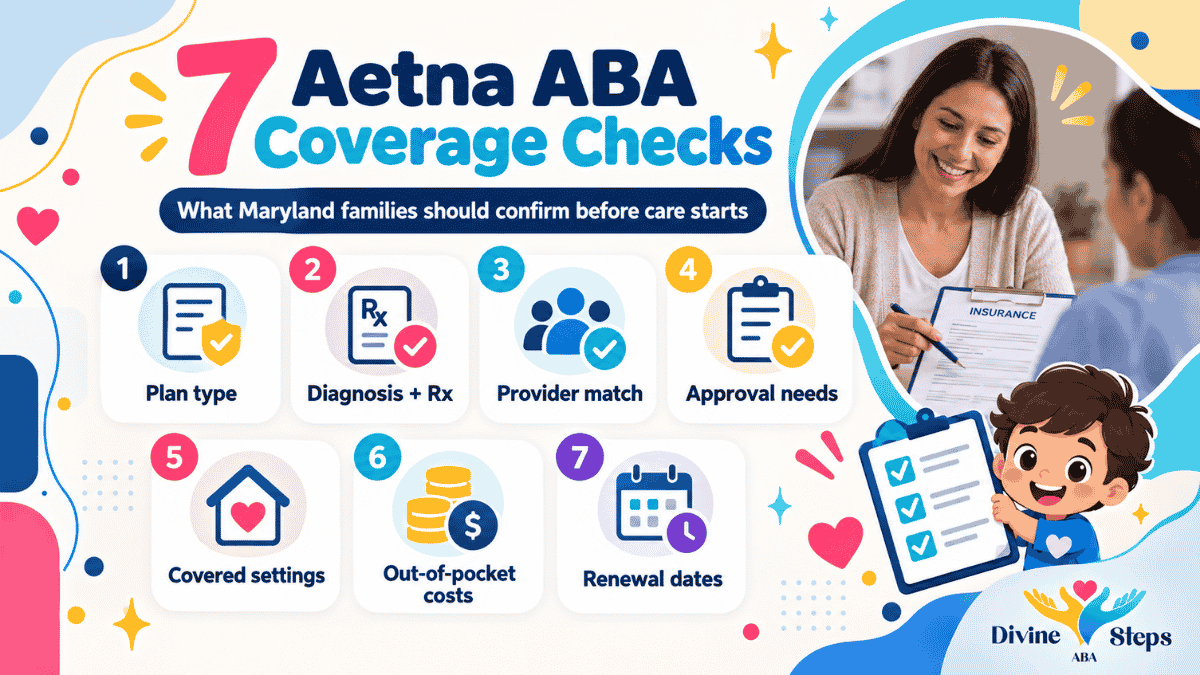
1. Check Whether Your Exact Aetna Plan Is Subject to Maryland Coverage Rules
Two families living in the same location can have Aetna cards, but their benefits may follow entirely different rules. That happens because some employer health plans are fully insured under state regulations, while others are self-funded by large corporations.
The Centers for Medicare & Medicaid Services advises families to ask their human resources department or plan administrator which model governs their policy. While Aetna maintains a dedicated section for plans subject to Maryland laws, your specific policy document remains the final authority.
To review your Aetna autism insurance in Maryland accurately, keep these key details nearby when reviewing your benefits:
- Exact Aetna product name listed on your insurance card
- Plan status indicating whether it is insured or self-funded
- Current benefit plan year start date
- Summary of Benefits and Coverage document
- Behavioral health customer service phone number on your card
2. Check the Diagnosis, Evaluation, and Prescription Requirements
Insurance providers review clinical documentation closely before agreeing to fund ongoing behavior therapy. Under Aetna guidelines for plans governed by state rules, a pediatrician or specialist must complete a formal evaluation, identify the clinical need for behavior analysis, and write a formal treatment prescription. Having those records organized speeds up the intake process significantly.
Our team provides ABA therapy for children ages 1 to 11 in Maryland, which means we often guide parents through gathering these initial health files. Confirming coverage for Aetna ABA therapy in Maryland means verifying that your physician's prescription includes clear, individualized goals.
- Gather the complete diagnostic report signed by a qualified clinician.
- Confirm your pediatrician wrote a current prescription for behavior therapy.
- Verify that the medical order outlines specific treatment goals.
- Keep recent medical and developmental evaluations ready for intake staff.
3. Check That the ABA Provider Meets Aetna and Maryland Requirements
Choosing a clinical team requires confirming state credentialing alongside insurance network participation. Aetna will only approve reimbursement when treatment is managed by appropriately credentialed clinicians.
While our team works with Aetna plans across Maryland, choosing an in-network ABA provider requires checking whether your exact product tier participates. Verifying network standing in advance protects your family from unexpected medical bills.
- Ask if the therapy team accepts your specific Aetna product group.
- Confirm in-network participation for your exact benefit plan.
- Verify that supervising clinicians hold current Maryland state licenses.
- Clarify who submits assessment requests and clinical reports.
- Request benefit verification before scheduling recurring sessions.
4. Check What Aetna Needs Before the First ABA Session
When starting ABA therapy with Aetna insurance, our intake specialists handle the submission details, so you don't have to manage paperwork on your own. We submit the initial assessment data directly to the clinical team for authorization review.
What Aetna ABA Therapy Coverage in Maryland Reviews Before Approval
Reviewers evaluate whether proposed interventions address measurable goals that build daily living skills.
During ABA sessions in Silver Spring, one child struggled with anxiety during the school lunch routine. Over several weeks, our therapist worked with him until he moved from needing constant physical prompts to opening his lunchbox independently and helping a classmate open theirs.
Seeing that kind of real-world progress is why insurance reviews prioritize objective, measurable outcomes.
- Clear documentation of functional challenges across daily routines
- Objective treatment targets that track meaningful skill growth
- Proposed therapy hours aligned with clinical recommendations
- A structured plan for family coaching and involvement
At Divine Steps Therapy, we can check your Aetna benefits and explain which records may be needed before ABA begins. If your family is unsure what your plan requires,
contact our Maryland team so we can review the insurance information with you.
5. Check Which ABA Services and Settings Your Aetna Plan Covers
Therapy can happen at home, at a local park, or during school-based ABA therapy, but insurance rules vary by environment. For plans subject to Maryland guidelines, Aetna states that it cannot deny coverage solely because therapy takes place in an educational setting.
However, insurance plans carefully distinguish between health insurance responsibilities and services provided by public school districts under federal education law. At Divine Steps, we deliver ABA services in home and school environments across Maryland communities, adapting goals to fit each setting.
Asking specific questions helps confirm that your plan includes Aetna coverage for autism treatment across all relevant environments:
- Does this plan cover home-based behavior therapy?
- Is school-based behavior support covered under this policy?
- Does the plan include caregiver or parent training in the approved hours?
- Does the service location change authorization requirements?
- Does the plan list any service limits?
6. Check Your Aetna ABA Therapy Cost Before Services Begin
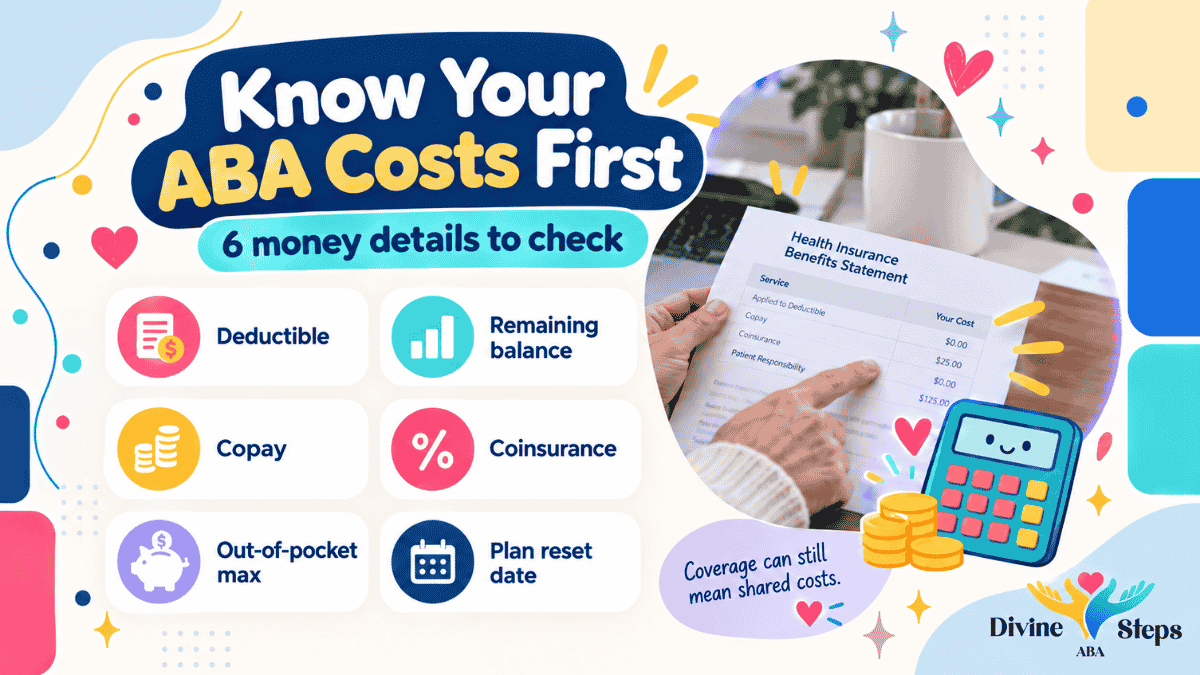
Understanding your financial responsibility prevents surprises once treatment starts. According to the 2025 KFF Employer Health Benefits Survey, 88% of covered workers with single coverage enrolled in a plan with a general annual deductible, averaging $1,886. A family may have active therapy coverage and still owe out-of-pocket costs while meeting that deductible.
The same survey reported that 34% of covered workers were in plans with a general single-coverage deductible of at least $2,000 in 2025. Checking your remaining deductible balance helps you plan your family budget accurately instead of asking only whether therapy is covered.
Confirming your specific Aetna ABA therapy cost breakdown gives you a clear picture of upcoming expenses:
- Deductible amount and remaining balance for the current plan year
- Whether ABA therapy is subject to that deductible
- Copayment amount required for individual sessions
- Coinsurance percentage owed after meeting the deductible
- Individual and family out-of-pocket maximum limits
- Exact date your benefit plan year resets
7. Check Reauthorization Dates and Report Insurance Changes Early
Insurance approval is an ongoing process, not a single event. Aetna policy guidelines require an annual reauthorization review to evaluate progress, update clinical goals, and reconfirm clinical necessity. Staying ahead of these submission dates keeps services running smoothly without gaps in care.
Our team handles ABA insurance verification and ongoing authorization work, but we ask families to tell us when insurance changes. One parent shared how much relief she felt when our team routinely checked in on her child's progress and promptly answered every follow-up question.
- Authorization start and end dates
- Date updated clinical records are due
- Annual review requirements with your physician
- New insurance cards or member identification numbers
- Changes to employer plans or secondary policies

FAQs About Aetna ABA Therapy Coverage in Maryland
Can Aetna deny ABA in Maryland just because my child's doctor recommends many hours?
For plans subject to Maryland law, Aetna cannot deny coverage solely based on the number of hours prescribed. However, the plan still reviews clinical necessity and treatment goals, so supporting medical records and progress reports remain essential for approval.
Does Aetna treat ABA as experimental treatment in Maryland?
For Aetna plans subject to Maryland law, guidelines state that coverage cannot be denied on the basis that ABA is experimental or investigational. Standard benefit terms and clinical necessity requirements still apply to your specific plan.
Do I need to understand my Aetna benefits before contacting Divine Steps?
No. Our team can start by reviewing the insurance information you currently have and explaining the next verification steps. One parent seeking Maryland ABA services came to us unsure of the process, then received clear support through intake.
Review Your Aetna Benefits With Divine Steps Therapy
Checking the insurance details above can give your family a clear picture of plan rules, approval requirements, covered settings, and out-of-pocket costs. However, your child's exact Aetna policy document remains the final source for benefit decisions.
At
Divine Steps Therapy, we support Maryland families by providing in-home and school-based behavior analysis for children ages 1 to 11. Our team can review your Aetna insurance information, explain which records your plan may require, and outline the next authorization steps. A benefits check can show what your specific plan requires before ABA therapy begins.

What to do after an autism diagnosis includes reviewing the report, calling insurance, and starting ABA and school referrals. Contact Divine Steps.

Switching ABA therapy providers can preserve goals, data, and routines while reducing care gaps. Your child's transfer can start with Divine Steps.

In-home vs school-based ABA therapy compares goals, routines, caregiver roles, access, and skill practice. Find the right setting with Divine Steps.